Compliance in construction is not glamorous. It does not win projects, impress clients, or make the front page of trade publications. But get it wrong — and it can shut down a site, trigger regulatory penalties, create personal liability for directors, and destroy a company's ability to bid for future contracts.
In India's construction sector, the compliance landscape is particularly complex. Labour laws, safety regulations, statutory contributions, environmental clearances, and contractual obligations all run simultaneously — and all carry consequences for non-compliance.
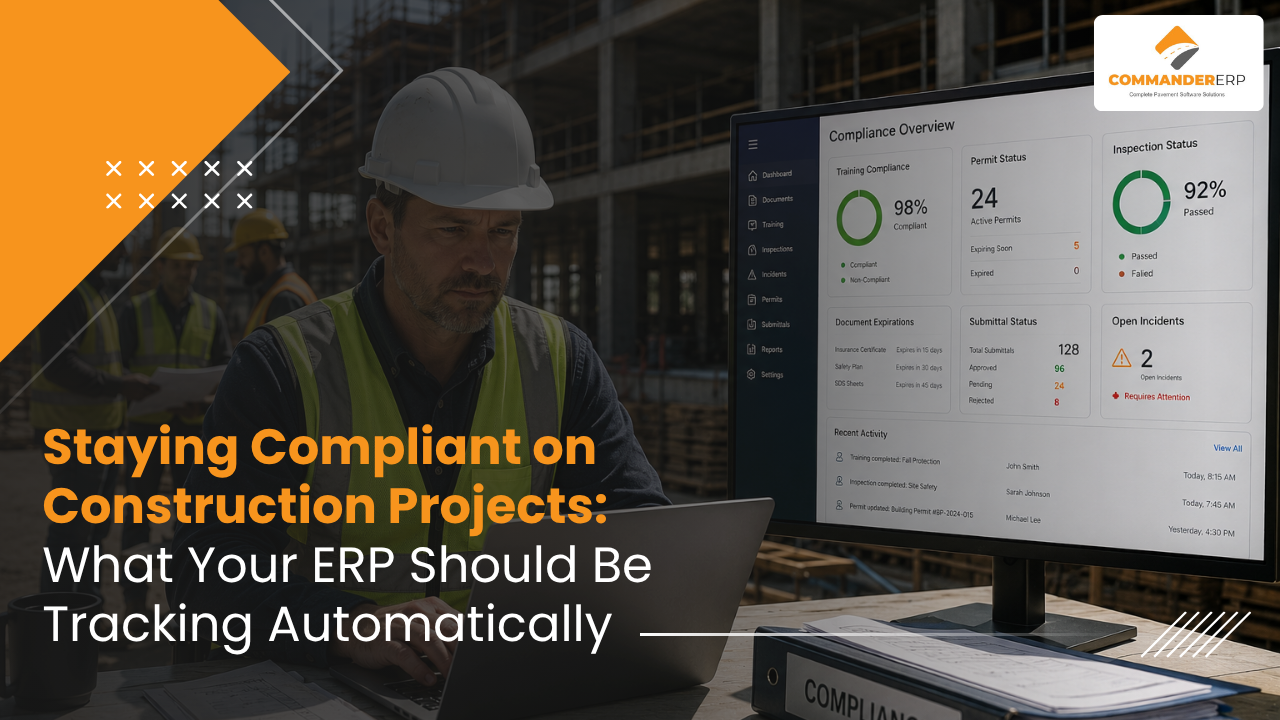
The good news: cloud ERP does not just manage your projects. It manages your compliance obligations too — automatically, continuously, and with full documentation ready for any inspection or audit.
The Compliance Landscape for Indian Construction Companies
Before looking at how ERP helps, it is worth understanding what compliance actually means for a construction business operating in India. It spans at least four distinct categories:
1. Labour Law Compliance
Construction is one of the most heavily regulated sectors for labour in India. Key obligations include:
- BOCW (Building & Other Construction Workers) Act — welfare fund contributions, registration of workers, cess payment
- Contract Labour (Regulation & Abolition) Act — principal employer obligations, contractor registration
- ESIC (Employees' State Insurance) — contributions for eligible workers
- EPF (Employees' Provident Fund) — deduction and deposit timelines
- Payment of Wages Act — payment frequency, deductions, and record-keeping
- Minimum Wages Act — state-specific rates, which vary and are revised periodically
Each of these has filing deadlines, documentation requirements, and inspection risks. A principal contractor is often jointly liable for the non-compliance of their subcontractors.
2. Safety and Health Compliance
Site safety compliance includes:
- Personal protective equipment (PPE) provision and usage records
- Incident and near-miss reporting logs
- Safety officer appointment and qualification records
- Toolbox talks and safety induction documentation
- Equipment inspection certificates (cranes, scaffolding, hoists)
- Emergency response plan documentation
3. Statutory and Regulatory Compliance
- RERA registration where applicable
- Environmental clearances and conditions of approval
- Local body permissions (building plan approvals, NOCs)
- GST compliance — TDS on contractor payments, input tax credit reconciliation
- TDS under Income Tax Act — Section 194C for contractor payments
4. Contractual Compliance
Beyond statutory obligations, most construction contracts include specific compliance requirements:
- Insurance certificates — contractor all-risk, third-party, workmen's compensation
- Performance bond and bank guarantee maintenance
- Quality inspection checkpoints
- Environmental and sustainability reporting
The Compliance Risk Matrix for Construction
| Compliance Area | Consequence of Non-Compliance | Who Bears Risk | Frequency of Obligation |
|---|---|---|---|
| BOCW Cess | Penalty + interest, site stoppage order | Principal Contractor | Per project value |
| ESIC / EPF default | Penalties, prosecution, bank attachment | Principal + Subcontractor | Monthly |
| Site safety violation | Stop-work notice, fines, criminal liability | Site Manager, Director | Ongoing / Daily |
| TDS non-deduction (194C) | Disallowance of expense, interest, penalty | Principal Contractor | Per payment |
| Insurance lapse | Uninsured loss, contract termination | Contractor | Annual renewal |
| RERA reporting delay | Penalty per day of delay | Developer / Builder | Quarterly |
How Manual Compliance Management Fails
Most construction businesses manage compliance through a combination of HR staff reminders, physical files, email alerts, and the memory of key individuals. This system works — until it does not. Common failure modes include:
- ESIC or EPF payments missed because the person responsible was on leave.
- Subcontractor insurance certificates expired without anyone noticing — discovered only during a client audit.
- BOCW cess calculated incorrectly because the rate was updated by the government and no one flagged the change.
- TDS deducted at the wrong rate because a new subcontractor's PAN was not verified before payment.
- Safety inspection certificates for equipment not renewed on time — equipment continues to be used, creating liability exposure.
The pattern is consistent: compliance failures happen not because people are careless, but because manual systems cannot reliably track dozens of obligations across multiple projects simultaneously.
What Your Construction ERP Should Track Automatically
Labour Compliance Module
Commander ERP maintains a labour register for each project — direct and subcontracted — tracking worker registrations, PF/ESIC numbers, wages paid, and BOCW contributions. Monthly compliance reports are auto-generated, and payment deadlines trigger alerts before they fall due.
Document Expiry Tracker
Every compliance document — insurance certificates, equipment inspection reports, contractor licences, safety officer certificates — is stored in Commander ERP with an expiry date. The system sends automated alerts 30, 15, and 5 days before expiry. No document lapses without someone receiving a warning.
TDS Compliance Integration
Contractor payments in Commander ERP automatically trigger TDS deduction calculations based on the applicable rate, vendor PAN status, and payment threshold. Deduction records are maintained for Form 26Q filing, reducing the risk of errors or omissions.
Safety and Incident Logs
Site teams log safety inspections, toolbox talks, and incidents directly from the mobile app. This creates a timestamped, geotagged record that satisfies regulatory documentation requirements and provides evidence of due diligence in the event of an inquiry.
Subcontractor Compliance Validation
Before a subcontractor payment is approved, Commander ERP checks that their compliance documents (insurance, EPF/ESIC registration, labour licence) are current. If any are expired, the payment is flagged for review. Principal contractors can demonstrate that they exercised due diligence — which matters when joint liability is asserted.
Building a Compliance Culture with ERP
ERP does more than track deadlines — it builds compliance into the workflow of everyday project management. When safety checklists are part of the site progress reporting routine, they get done. When compliance document renewal is an automated alert rather than a manual calendar entry, it does not get missed.
Over time, this shift from reactive to proactive compliance management changes the culture of a construction business. Teams stop thinking of compliance as a burden and start seeing it as part of delivering a project properly.
What to Look for in a Construction ERP Compliance Module
Not all ERP systems handle construction compliance equally. When evaluating a platform, look for:
- Labour law compliance built for the Indian construction context — BOCW, CLRA, EPF, ESIC
- Document management with expiry tracking and automated alerts
- Integration between site activities and compliance documentation
- Subcontractor compliance validation before payment approval
- Audit trail — every action timestamped, every document version retained
- Mobile access for site-level compliance reporting
Commander ERP is designed with all of these capabilities — built for the compliance realities of Indian construction, not adapted from a generic international platform.
Conclusion
Compliance is not optional in construction — it is a licence to operate. The businesses that treat compliance as a system rather than a task are the ones that never face emergency site shutdowns, regulatory fines, or the reputational damage of a publicised violation.
Cloud ERP makes compliance automatic. Every obligation is tracked, every deadline is flagged, every document is stored, and every payment is checked before it leaves the business. That is not just good practice — it is good business.
Make Compliance Automatic, Not an Afterthought
Commander ERP tracks every compliance obligation — labour, safety, statutory, and contractual — so your team can focus on building, not paperwork.
Book a Free Demo at commandererp.com